

From selfishness to cooperation
Why IOTA is the future model
Today we live in a world of abundance, at least the Western oriented cultures. Without regard to the earth, animals, plants and even other people, resources are wasted. The ecological footprint is a nice way to show this waste. The overshoot day, the day in a year when mankind has consumed the natural annual resources of the earth, comes earlier and earlier.
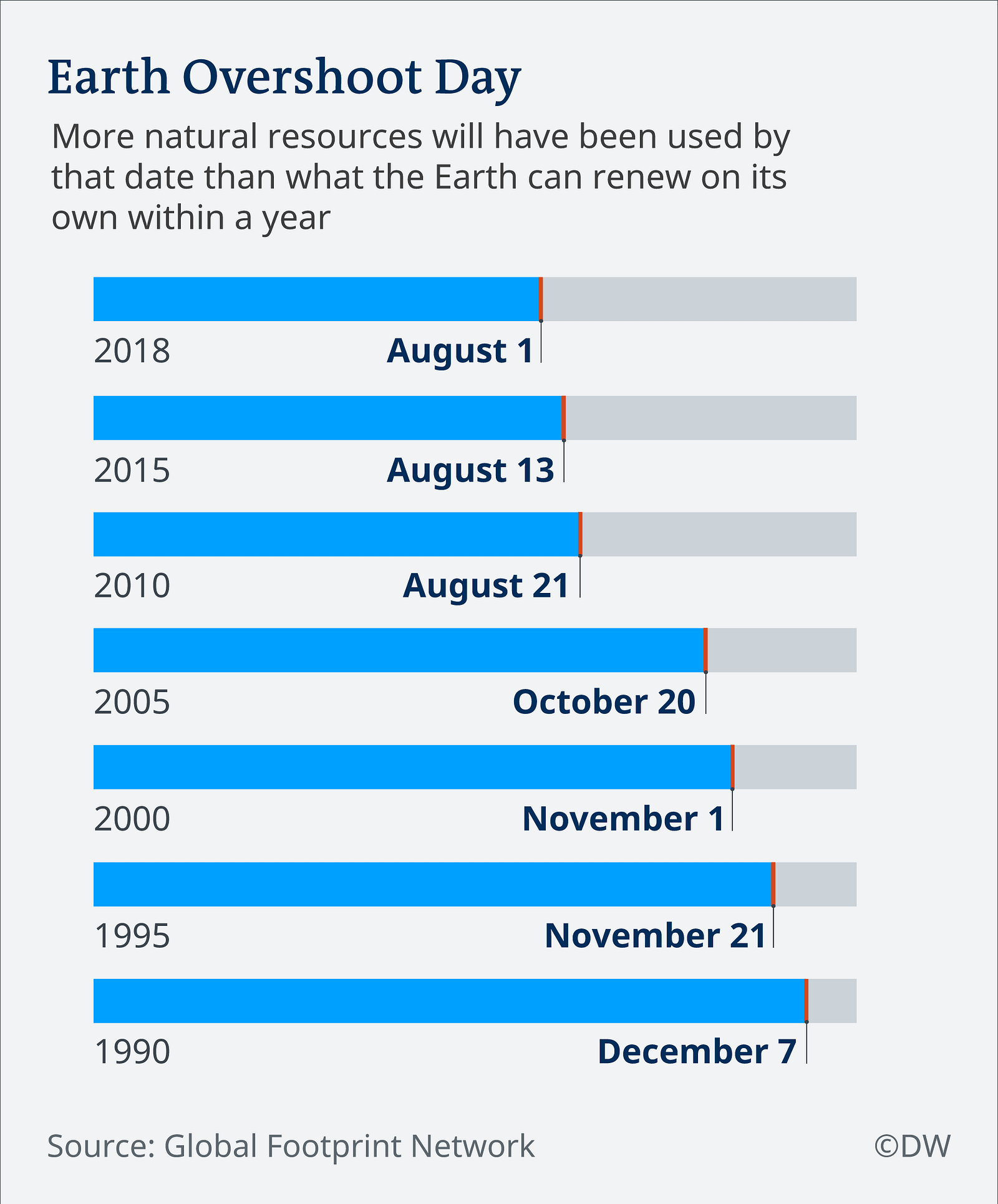
Wars are waged so that the powerful retain access to the resources they need to satisfy their own society. With the resources whole peoples are soothed, consumption is gloryfied, capitalism is deified.
“Everyone is the architect of his own fortune” said the Roman poet Appius Claudius Caecus (about 300 BC). Today selfishness is held high. We live in a time in which, unfortunately, many consider themselves more than those around them. It is chic to build a reality against the outside that does not correspond in any way to what one is. We have to exist in a world full of competition. We only see what we want to see and we only show ourselves as we want others to perceive us. For me, “Make America great again” is a saying that has turned nearly half of an entire nation into narcissists. Why not “Let’s make humanity great again”?
We have arrived at a point where the question is worth asking, is man really like that?
The selfish gene and the prisoner’s dilemma
As early as 1976 the British ethologist and evolutionary biologist Richard Dawkins published his greatest work to date “The selfish gene” in which he, overstated, says that a single gene is the smallest unit of egoism. Since the basis of our life is based on egoistic particles, which are only meant to secure their own survival, this should also have implications for the behaviour of the whole organism. Even social groups therefore behave selfishly and at the expense of other groups when it comes to survival. To put it bluntly, altruistic behavior would only make sense if it serves to spread one’s own genes.
A little earlier, in 1950, Merrill Flood and Melvin Dresher developed a game at the RAND Corporation, which was formalized by Albert W. Tucker and went down in history as “The prisoner’s dilemma”. The game is so ingeniously simple that many people think that there’s more to it than that. Entire bookshelves are still filled with treatises on this game in many different variations, which are always the same. The basic principle of the game is therefore explained here (see also Wikipedia):
Two members of a criminal gang are arrested and imprisoned. Each prisoner is in solitary confinement with no means of communicating with the other. The prosecutors lack sufficient evidence to convict the pair on the principal charge, but they have enough to convict both on a lesser charge. Simultaneously, the prosecutors offer each prisoner a bargain. Each prisoner is given the opportunity either to betray the other by testifying that the other committed the crime, or to cooperate with the other by remaining silent. The offer is:

- If A and B each betray the other, each of them serves two years in prison
- If A betrays B but B remains silent, A will be set free and B will serve three years in prison (and vice versa)
- If A and B both remain silent, both of them will only serve one year in prison (on the lesser charge).
Most games are zero-sum games, which means that if a player wins something, the opponent loses exactly the equivalent of it. In a non-zero sum game, however, the win of one is not necessarily the loss of the other. The Prisoner’s Dilemma is the classic of non-zero game, because reward and punishment are not reciprocal.
It is assumed that both prisoners understand the nature of the game, have no loyalty to each other, and will have no opportunity for retribution or reward outside the game. Regardless of what the other decides, each prisoner gets a higher reward by betraying the other (“defecting”). The reasoning involves an argument by dilemma: B will either cooperate or defect. If B cooperates, A should defect, because going free is better than serving 1 year. If B defects, A should also defect, because serving 2 years is better than serving 3. So either way, A should defect. Parallel reasoning will show that B should defect.
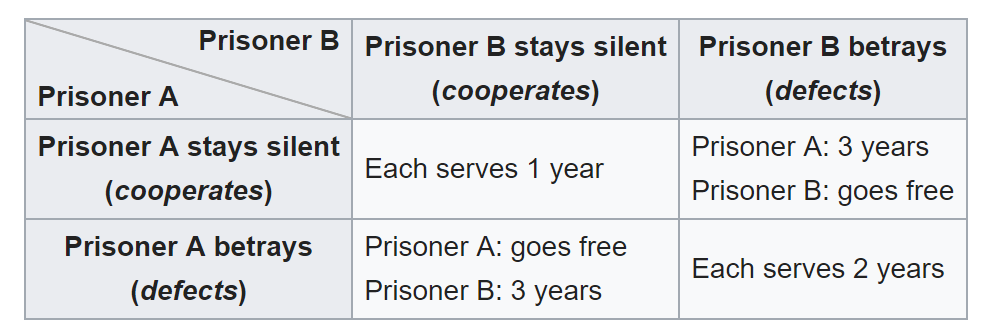
Because defection always results in a better payoff than cooperation regardless of the other player’s choice, it is a dominant strategy. Mutual defection is the only strong Nash equilibrium in the game (i.e. the only outcome from which each player could only do worse by unilaterally changing strategy). The dilemma, then, is that mutual cooperation yields a better outcome than mutual defection but is not the rational outcome because the choice to cooperate, from a self-interested perspective, is irrational.
In reality, however, people tend to cooperate even in a unique game. So they do not act strictly rationally.
In most cases, the game was assumed to have inexhaustible resources. But if we transfer that to the real world economy, we find that resources are not infinite. A new study on the topic of Seifi and Crowther (Seifi and Crowther, Ind Eng Manage 2018, 7:1) takes into account the impact of resource depletion on the game.
Resource scarcity is a reality in today’s economic environment. The consequence of this irrefutable fact is that the use of resources by one company harms another company. The competitive situation for the diminishing raw materials makes a strategy of cooperation impossible. What follows are takeover battles and the monopolization of markets. In simple terms it can be said that cooperations are only entered into in dependency relationships, but in the competitive situation everyone looks at it for himself. Normally a company will not cheat a supplier and the supplier will not deliver bad goods. But companies that are looking for the same market will always be out to chase the other market share and the ways and means can be sinisterly hypocritical and vicious. As long as a competitive situation prevails among suppliers, the consumer ultimately has the opportunity to reward or punish them with his choice. If, however, the consumer is dependent on a monopolist, he is at the mercy of that monopolist. The authors of the study claim that the best strategy in the case of a scarcity of resources would actually be cooperation. But this can usually only be enforced by external pressure. A good example of this are the CO2 certificates that are traded today. They create a kind of cooperation mechanism without individual countries having to renounce their wasteful use of non-renewable energies.
If we now go back to the empirical findings in the Prisoner’s Dilemma game, people seem to include their years of life in their decision as an exhaustible resource. They do what is rationally most favourable when resources (life years) are scarce: they cooperate. Maybe this is the most misunderstood point in the prisoners dilemma, and the reason why people do have a tendence to cooperate.
And what does it look like in Crypto Space?
If we now refer these theories to the space of crypto currencies, we can see why very few currencies offer a solution for a prosperous future.
Actually, the basic idea behind crypto currencies is that the parties involved trust each other and thus cooperate. It is through this cooperation that the blockchain is made possible. And the trust is based on the fact that every transaction is publicly visible. Trust is also created by the fact that the majority decides what is a valid transaction and what is not.