

TOQEN — A Third Layer Cryptocurrency bringing Smart Contracts to IOTA
One of the most exciting features of Distributed Ledger Technologies are Smart Contracts: decentralized contracts which are not controlled by a single entity and will inevitably be settled the way the contract author programmed them to do. Smart contract platforms such as Ethereum have emerged to become the second generation of cryptocurrency. However, recent events have made it obvious that the nature of blockchain technology prevents it from executing such contracts in a fast, cheap and scalable manner.
The IOTA protocol, on the other hand, which utilizes a DAG architecture (Tangle) to solve the scaling problems of blockchain, unfortunately lacks support of native smart contracts. This is also the reason why Oyster Pearl was forced into becoming a hybrid project utilizing both IOTA for data storage and Ethereum for automatic settlements. Therefore the question arises whether smart contracts could be implemented into IOTA on a higher abstraction level.


Announcing TOQEN
TOQEN, built on top of Qubic Lite, which itself is built on top of the IOTA Tangle is a new proof-of-concept cryptocurrency approach that tries to supplement the IOTA protocol by providing it with smart contracts. The consensus of the public ledger is built by a qubic consisting of multiple independent oracles which validate and confirm any transaction happening in the TOQEN network.
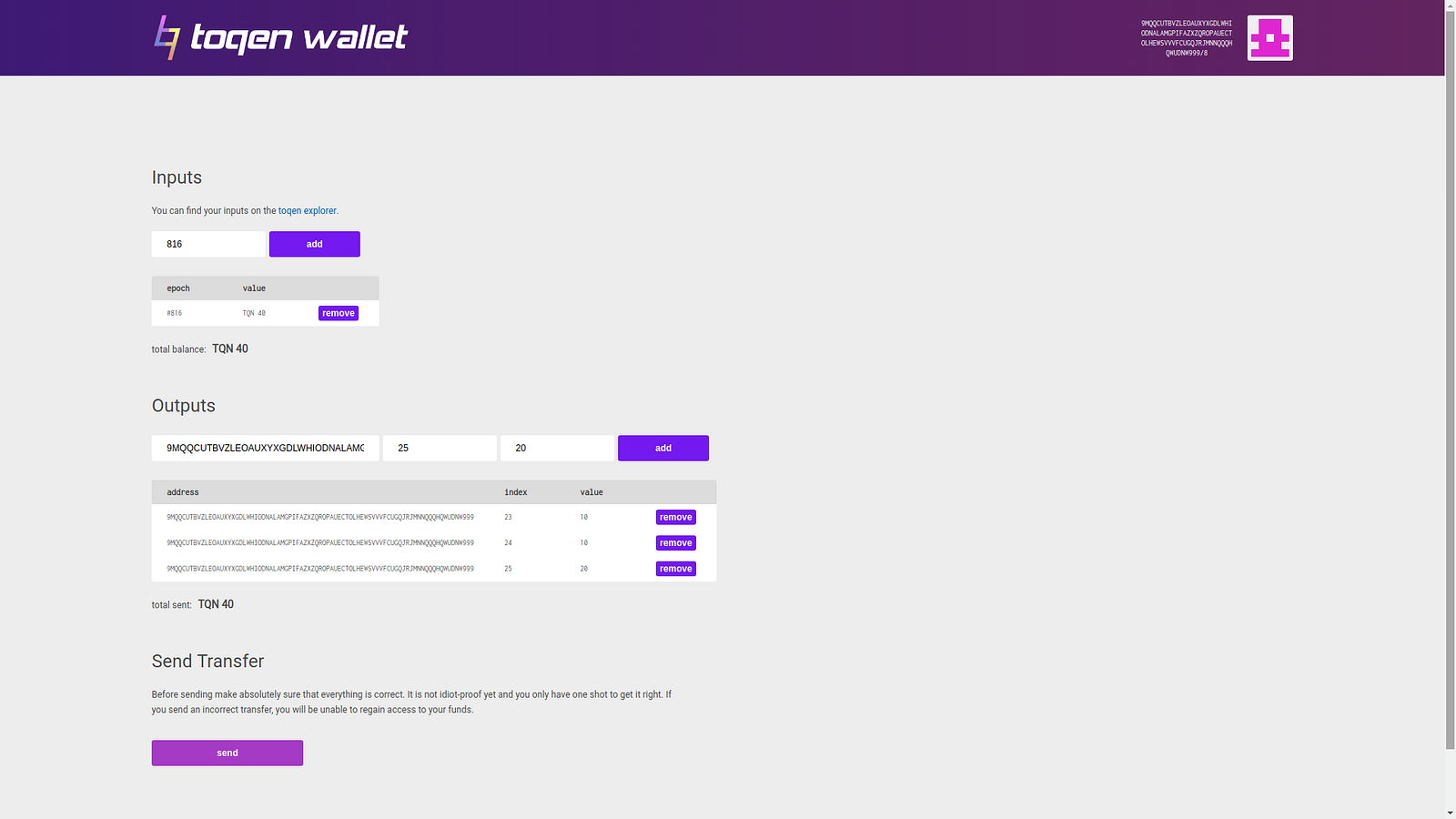
A first theoretical concept for such a qubic cryptocurrency has been described in this article back in June. With the development progress of Qubic Lite, building TOQEN appeared to be the perfect way of demonstrating the technical capabilities of the Qlite protocol. Now, with this article, an early TOQEN prototype will be released. Smart contracts are not included yet and will be implemented in the near future. However, it already allows you to send peer-to-peer value transfers, which is definitely enough of a feature for now.
Theory and Features
Blockchain
TOQEN works like a blockchain and therefore, unlike IOTA, cannot scale vertically (at least for now; it would require a few major adjustments to the Qubic Lite protocol). However, scaling could happen horizontally by allowing multiple TOQEN Qubics to interact with eachother by exchanging TQN through atomic swaps.
Coordinator
Although TOQEN runs on IOTA, it is completely unaffected by the coordinator since Qubic Lite does not depend on IOTA transaction confirmations. Hence it might offer an alternative way to send value via the IOTA network in times of heavy Tangle congestion.