

Unpopular opinion: Bitcoin did not get rid of the middle-man
The general narrative about Bitcoin seems to be, that Bitcoin got rid of the middle-man, aka people that you have to pay money to process your transactions and that can, in theory, censor you. Even the 2008 Bitcoin white-paper is titled “Bitcoin: A Peer-to-Peer Electronic Cash System”, implying that any user can give their money directly to any other person.
My hot-take: Bitcoin is NOT a peer-to-peer electronic cash system because users are not able to directly send tokens to any other person. There is still a middle-man in the system: The miners (in other projects: stakers).
Why miners are middle-men
In order to issue a transaction on the blockchain nodes (aka users) must ask the miners to include their transactions into the next block. In order for the miners to consider ones transaction, they have to be bribed by offering money (transaction fees). This already means that nodes CANNOT directly write their transaction into the blockchain — only miners can do that. That’s the perfect definition of a middle-man: Someone you HAVE TO pay in order for them to do something for you, because you cannot do it yourself.
Ok miners are middle-men, but they are decentralized, right?
Keep in mind: Miners are not crypto-enthusiasts, anarcho-capitalists or fighters for financial freedom. They are businesses. Professional mining today requires initial investments of hundreds of millions of Dollars to even start business. This money comes from rich investors that don’t necessarily have any interest in the “freedom crypto” narrative, but only in return of investment (ROI).

These businesses pay large teams of professionals to set up and maintain complex mining-rigs at several locations around the globe and negotiate prices and regulations with local or national power-suppliers. All these jobs are again not done by freedom-fighters or anything like that, but by regular professionals, as they work in every other company. Small-scale mining by private people plays virtually no role in todays crypto landscape and you can bet that the process of professionalization will only continue over time, as long as there is profit to be made.
So we have here a completely normal, non-idealistic new market emerging. How do emerging markets ALWAYS behave? They consolidate to become more profitable. Big and profitable businesses buy smaller, less profitable businesses or fusion with large competitors. The market centralizes.
Today there are already only 4 mining pools that together create about 51,5% of the total hash-power of the Bitcoin network. Two of these pools (antpool.com and f2pool.com) being managed by one umbrella entity, Bitmain.
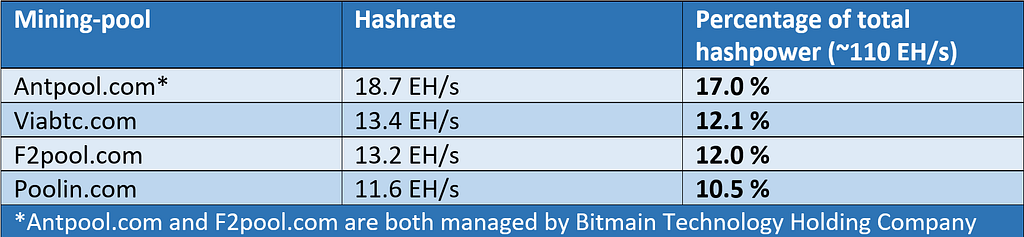
Have you ever heard of the Nakamoto Coefficient? It is the minimal number of validators of a decentralized network that together could control the network (in Bitcoin: create 51% of the total hash-rate). This means, the Nakamoto Coefficient of Bitcoin is 3 Literally 3. Any entity that can control these 3 mining-companies either politically, financially via back-door deals or by any other means, can effectively control and censor the network. This number will presumably only go lower over time, as business consolidates.
Censorship on the Bitcoin blockchain — How mining companies can be politically controlled