
Parallel realities and IOTAs breakthrough “Multiverse consensus”
Fun fact about our universe: There is no objective time. Every observer experiences their own duration and series of events, depending on their relative speeds to each other. Even the order of events gets blurred: Two events that happens simultaneously for one observer can happen one-after-another for the other (see ladder-paradox).
Why am I telling you this on a crypto-currency subreddit? Because within distributed ledgers (like blockchains or DAGs) there is also no objective series of events. Each node in the network experiences its very own order of transactions. And believe it or not: This relativity of time is the reason you pay fees on your Bitcoin transactions.
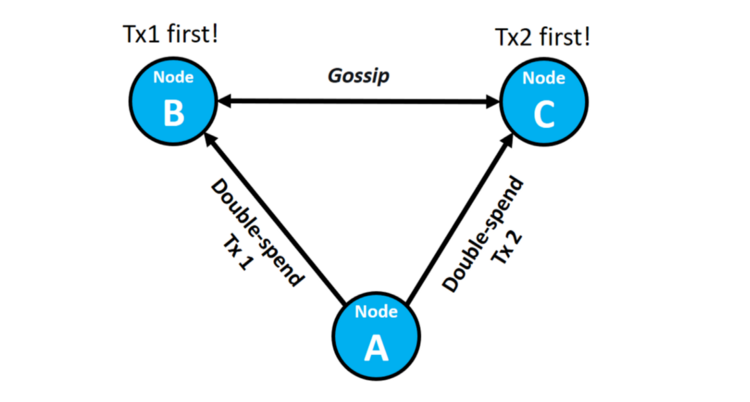
Time-relative networks are vulnerable to double-spends
Distributed networks are made up of nodes that tell to each other their opinion on the ledger-state. So when a node wants to issue a transaction it starts by telling it´s neighboring nodes about it. They then forward it to their neighbors and so on — information ripples through the network. This form of communication is called “gossip” and is highly scalable. However, a fundamental side-effect is that the time and order of transactions becomes relative. Each node sees its own version of reality, just like observers in the physical universe. Problem: This opens up vulnerabilities for double-spends.
Crude but working solution: Pay someone to deal with conflicts
To this day, no blockchain found a solution to constructively work with relativity of time. Instead, the double-spend problem is universally solved in a rather simplistic way: Slow down the network and organize it into artificial checkpoints, aka “blocks”, in order to synchronize opinions. The problem is that these blocks do not evolve naturally out of the distributed ledger. Instead an outside entity is needed to arbitrarily define them. This entity is called a “leader” and is usually determined by proof-of-work (miners) or proof-of-stake (stakers). They make sure to create a block with no internal conflicts.
And it works: this method solves the double-spend problem. However, it also comes with several high costs:

Problem 1: Leaders slow everything down
Finding a leader costs time. Instead of having a continuous and smooth flow of transactions, the network gets stopped in fixed intervals (block-times). Only AFTER a block is fully validated the next batch of transactions can be processed.
Problem 2: Leaders want your money
Miners and stakers can only be trusted, because we count on their financial self-interest. This financial interest must be continuously satisfied by fees and/or token inflation. Fees however run exactly contrary to the usability of the network: They are a direct incentive to NOT use the network and they destroy many possible use-cases (see No-coin DLT use-cases).
Problem 3: Leaders are middle-men
As long as regular nodes cannot directly write transactions into the ledger themselves, but instead have to pay thirds parties (miners/stakers), cryptocurrencies are not really what Satoshi originally envisioned: “peer-to-peer electronic cash”. There will always be a lot less leaders (for example mining-pools) than nodes on the network (in Bitcoin 4 mining-pools control 51% of hash-power..). This has serious long-term problems which are discussed here.
IOTAs radical idea: Accept relativity of time, throw out miners/stakers
One of the fundamental concepts of IOTA is to NOT insist on a total order of transactions. This single decision has immediate and strong consequences on the network: