

Project UNIO – EDF Milestone update
During the last four months we have made great progress on our mission to unify Tangle.Glumb, Tanglemonitor & Tanglebeat into a single public service site. With this post we want to update you on the work we have done so far and which steps will follow until the final project milestone in December.
If you like, you can read up on the initial EDF announcement of our project.
Service name
First of all, we have decided to name the unifying successor tangleview. We believe this name provides a better association to the purpose of the project than ”UNIO”.
Back-end
The primary work so far has been done on the back-end side. The major challenge was to (1) conceptualize the actual data / communication flow between the apps, (2) implement / adapt the concepts into our present apps and (3) provide an easy deployment system (via docker).

To get a better understanding, the following scheme illustrates the interconnection between all the modules:
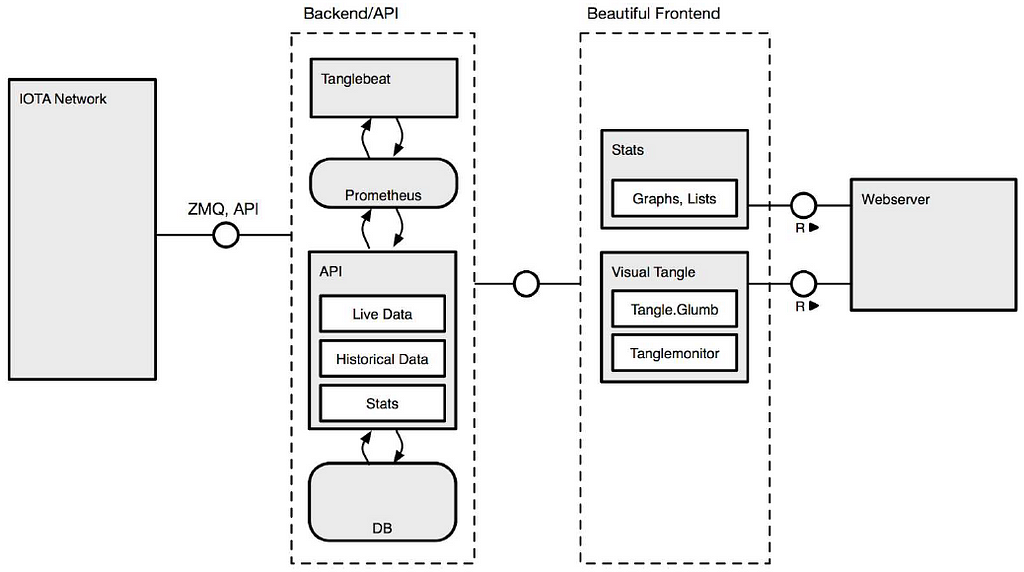
The Tanglebeat instance collects and streamlines an arbitrary amount of ZMQ channels (nodes) and feeds all relevant Tangle data / metrics to Prometheus and the API instance (via NanoMsg channel). Of course, Tanglebeat -what it is known for- also sends custom transactions to collect actual confirmation times of the network.
The API instance provides WebSocket channels and API endpoints for front-end applications. All storage relevant data, primarily the Tangle transaction history, gets stored into a MongoDB instance. This DB type suits all our current needs and will also cover all requirements for the future, especially in regards to scalability and redundancy.
Front-end
Currently we are working on the front-end application or in other words: The public website / service which will host tangleview. As of now, we already have dedicated sections of each tool (Tangle.Glumb: Topology graph, Tanglemonitor: Confirmation process visualizer, Tanglebeat: Metrics & Charts). Further, there is a new dashboard, which displays all the relevant visualizations & charts onto a single page: