
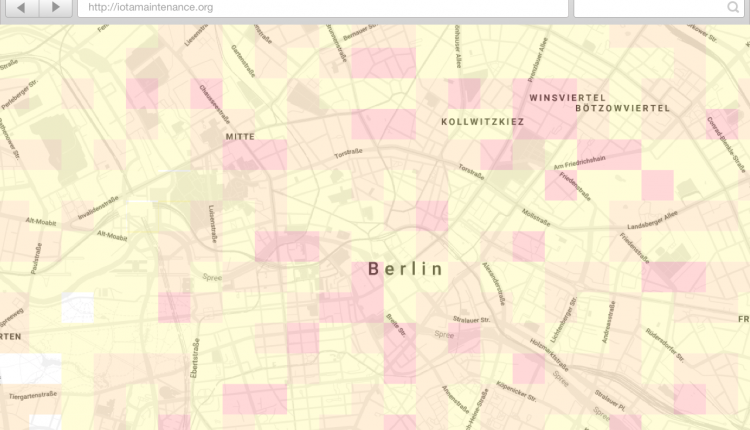
The perfect brainstorm: Public infrastructure monitoring
The perfect brainstorm: Smart city infrastructure monitoring
While this proposal by far doesn’t address one of the important challenges humanity faces, it might make a good case to demonstrate the benefits of DLTs — and in particular of IOTA — while including the general public, namely “non crypto”-enthusiasts.
You be the judge whether this idea is worth following up.
Preface
Roads are something we all take for granted. But in fact, our roads are the arteries supplying the heart of our global economy. To keep the economy running, road infrastructure has to be well maintained and any damage has to be fixed.
Time is an important factor in road maintenance: A small crack grows easily into a serious pothole within a winter season. And who hasn’t heard the argument of businesses relocating because of „better infrastructure“?
Roads carry an importance we usually miss to see.
Damaged roads add cost to the economy, not only in terms of repairs, but also delays and their consequences. Accidents due to bad infrastructure are usually followed by secondary burdens like further delays, possibly higher cost due to more serious damage and sometime tertiary cost like healthcare, in case of injuries.
When it comes to road infrastructure, waiting with repairs thus automatically results in increased risk and additional cost down the road (pun intended).
Long story short: the sooner any damages to road infrastructure are tended to, the lower the economic burden on society.
The problem
Processes for maintaining public road infrastructure are as archaic as you could possibly imagine.
As of today, maybe a few bored seniors but mostly police officers or observant public servants report road damages – if they find the right contact to submit a report. In addition, some municipalities actually employ people driving around all day, looking for damages.
When a report does find its way, usually an inspector is dispatched to check the reported damages, not rarely arriving at the reported location just to find that the damage isn’t severe — or not finding any damage at all, because the location description was not accurate enough.

Reporting damages is a completely unstructured process, riddled with inefficiencies, delays and loss of data.
In return, municipalities responsible for maintaining roads don’t have information about their current condition and have no efficient means of gathering information about the status quo.
The following idea could change that.
The pitch
In essence, this idea revolves around a global road monitoring system.
The core of this idea is to equip the worldwide road infrastructure with a tight sensor array that automatically monitors road conditions in order to detect any damages and thus enable municipalities and public services to drastically improve their processes and allocation of resources — and ultimately lower the monetary burden on tax payers.
You probably think I am nuts.
It’s actually pretty easy and hardly costs anything:
Most people use means of transportation like cars, bikes, motorcycles, buses, bicycles or trains on a daily basis. And the vast majority of them carries a smartphone in their pocket that includes an array of roughly a dozen fairly precise sensors.
In fact, data is being gathered by numerous smartphone apps already while we carry our phones around, as recently demonstrated in a detailed article by the New York Times. Unfortunately their owners are usually neither aware of their every movements being tracked, nor are they rewarded for their unknown “contributions”.
We are going to tap into this already existing, widely available, global sensor array in order to gather data about road conditions on a worldwide level— but by including users on their own will, on their terms and in an anonymous (or at least pseudonymous, see paragraph further down) fashion, while rewarding them for their contributed information.
All we need is a smartphone app being able to register vibrations while we drive, ride, cycle or use trains.
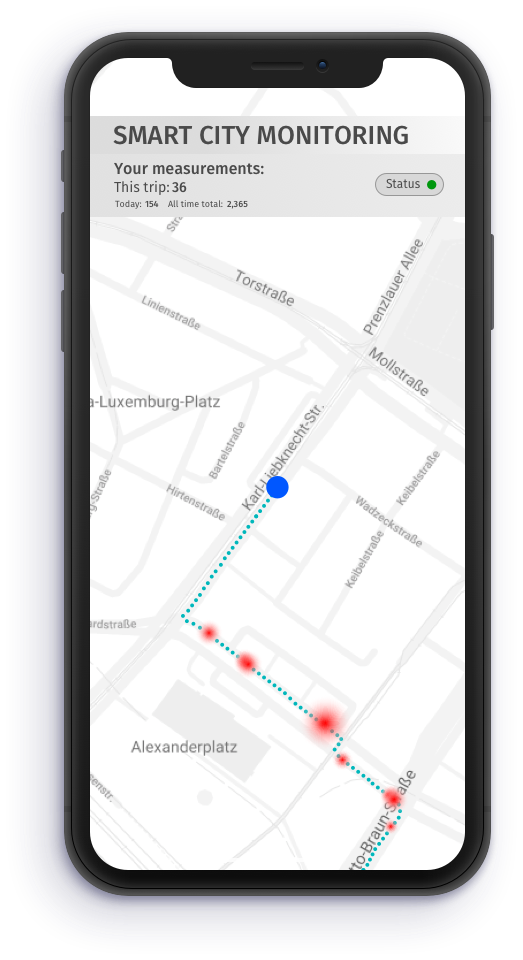
The app taps into the smartphones’ sensor data (accelerometer, gyroscope, shock sensors, positioning systems, etc.) and registers vibrations if the user drives over a bump, a crack or a pothole.
Whenever the app registers such events, it writes the gathered data in a standardised form (eCl@ass?) to the IOTA Tangle.