
Wallet and User Account in Several Cryptocurrency Systems – IOTA
We now take a look on IOTA wallet.
IOTA Overview
IOTA is another public ledger targeting the IOT economy: huge amount of users / devices while transaction amount is small. It resolves the challenges by introducing Tangle, a Direct Acyclic Group (DAG) approach claimed to be superior to conventional blockchains. The Tangle is constructed by every participants and therefore it is transaction fee free. IOTA also comes with some specific encoding mechanism (Ternary).
This article is more focusing on user account and address and the wallets.
IOTA Address Scheme
While the essential transaction signing follows the basic (private key -address) pattern, IOTA takes a different approach compared to those ledgers mentioned above. We will introduce it here.

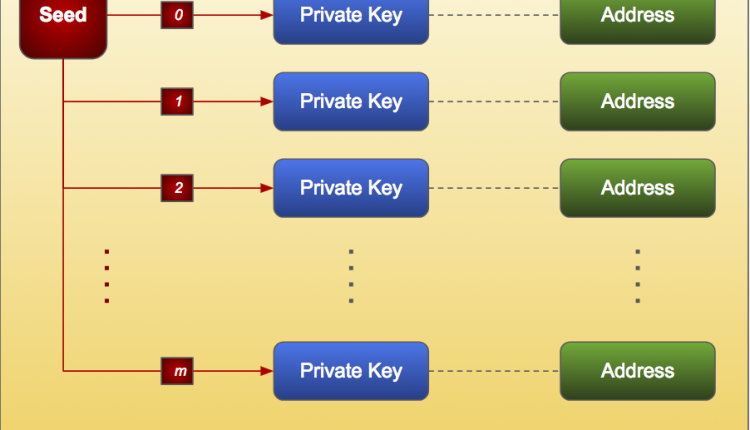
IOTA addresses are rooted from a seed, a random number that makes every user account unique. Seed is the most critical element that one needs to keep privacy. From the seed, a list of (private key – address) pairs are generated. This is deterministic. As far as the same seed is given, the same list of (private key- address) pairs are always generated.
Technically, each (private key – address) is calculated from the seed and an index number. The same seed and index number will always have the same address.
IOTA Wallet
With the knowledge of IOTA address scheme, let’s take a look on the IOTA wallet. As we can see, the wallet requests a seed. The IOTA Light Wallet I am using is just a user interface showing the address associated to the seed and the balance calculated. Here we see my current balance is 1000 iotas.
How is the balance calculated? Both Ethereum and NEM the balance is a state of an address. IOTA here is a bit close to how Bitcoin works, although the address generation mechanism is different. As user is identified by the unique seed, the balance of that user is therefore all the balance associated to the addresses generated from that seed.
We can have